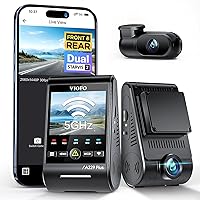
Is There a Battery-Operated Dash Cam?
Yes, a battery-operated dash cam exists, but the battery only powers parking mode, not recording during a long drive. Most cameras run on a supercapacitor or a small internal battery and charge from your car while you drive. For true overnight power, drivers add a separate battery pack.
On this page (7 sections)
- Is there a battery-operated dash cam that records without the engine running?
- How is a battery-operated dash cam different from a supercapacitor camera?
- What does a dash cam battery pack actually do?
- Which dash cam battery pack should you pick?
- How long can a dash cam run on battery power?
- Can a dash cam battery pack damage your car?
- So, do you need a battery-operated dash cam?
Yes, a battery-operated dash cam exists, but the battery only powers parking mode, not recording during a long drive. Most cameras run on a supercapacitor or a small internal battery and charge from your car while you drive.
For true overnight power, drivers add a separate battery pack.
The phrase "battery-operated" means two different things in dash cam shopping. Sometimes it means a camera with an internal cell.
Sometimes it means a camera paired with a backup battery pack that runs parking mode. Knowing which one you're buying keeps you from a dead car battery.
Is there a battery-operated dash cam that records without the engine running?
Yes, but only for a limited time. A camera's internal battery or a supercapacitor holds enough charge to keep parking mode alive for a short stretch after you park.
It won't record all night.
Parking mode is the feature you want. The camera stays in a low-power state and wakes to record when motion or impact is detected.
How long that lasts depends on what's feeding it.
A built-in cell runs a single-channel cam for a short time. A dedicated pack runs it much longer.
That gap is why the battery pack market exists at all. A pack like the 96Wh units below is sized to carry the camera through a night in a lot or on a street, not just the few minutes a small internal cell can manage.
If you're still deciding whether parking footage matters to you, our guide to do I need a dash cam covers the everyday reasons drivers buy one.
How is a battery-operated dash cam different from a supercapacitor camera?
The power source is the difference. A supercapacitor stores charge briefly and releases it fast.
A battery holds more energy but ages faster in heat.
Supercapacitors are common in windshield cameras for a reason. They handle summer heat better and last longer than small lithium cells.
The trade-off is that a capacitor holds very little energy, so it can't run parking mode on its own for long.
The supercapacitor vs battery dash cam comparison breaks down which one suits hot climates and which one suits long parking sessions. For most drivers, the camera's internal power source matters less than the backup pack behind it.
One practical detail: a dedicated pack moves the heat problem off the windshield. The pack uses LiFePO4 cells, which are more stable in high temperatures than standard lithium-ion.
It can sit in the glove box or under the seat, away from the sun that hits the glass.
What does a dash cam battery pack actually do?
It charges while you drive, then powers the camera when you park. The pack sits between your car's electrical system and the dash cam.
Once the engine stops, the camera draws from the pack instead of the car battery.
That setup keeps your car battery out of the parking-mode loop. You avoid the flat-battery morning that comes from a camera wired straight to the fuse box with no cutoff.
A pack also lets parking mode run longer. The bigger the pack's capacity, the more hours the camera keeps watching.
Our guide to the dash cam battery pack covers how to size one for your driving habits.
The charge step matters as much as the capacity. A pack that fills slowly needs a long commute to top up.
A pack that fills in under an hour recovers from a short drive, which is why the charging figures below are worth checking against your daily routine.
Which dash cam battery pack should you pick?
The BlackVue B-130A is the strongest pick for most drivers, because it pairs high capacity with up to 30 hours of parking runtime, extendable longer with select BlackVue Elite Series cams. The other two fit specific cars or budgets.
Who should pick the BlackVue B-130A?
Pick the B-130A if you want long parking coverage and app monitoring. Its 12.8V / 7,500mAh cells hold 96Wh.
BlackVue says that's up to 30 hours for a single-channel camera and about 15 to 20 hours for a dual-channel setup.
It supports both 12V and 24V systems, so it works in cars and heavy-duty trucks. The BlackVue App shows real-time charge percentage and remaining parking time.
A 5V USB-A port charges a phone or hotspot to keep a cloud camera online.
Heat protection is built in. Above 80°C the pack beeps and flashes, then stops charging until it drops below 70°C.
Charging resumes on its own once it cools below that mark. The kit includes the battery, a hardwiring cable, a cigarette lighter cable, a fuse tap kit with three fuse types, and velcro tape.
The catch is compatibility: it's designed for BlackVue cameras, so check your model before you buy.
Who should pick the 70mai BL96NNX?
Choose the 70mai pack if you drive a non-BlackVue camera and want wide voltage support. Its input range runs from 11.2V to 30V, and the XT30 output simulates a car battery signal so most dash cams can use it.
It's also 96Wh / 7,500mAh, and 70mai says a hardwired connection fills it in about 60 minutes. The 2,000-cycle LiFePO4 cells keep about 70% capacity after that many charges.
Parking runtime lands near 30 hours at a 3W draw. A 20-second delayed charging start protects the car's electrical system when you turn the ignition.
One thing to know: 70mai's parking time figures vary by camera model. The brand lists 19 to 51 hours depending on which 70mai cam you pair it with.
It charges through a fuse box connection only. The kit includes a 3.3m Type-C output cable and a parking surveillance cable adapter, so check that your camera's parking wire matches the VCC, ACC and GND terminals on the pack.
Who should pick the REDTIGER LiFePO4 pack?
Go with the REDTIGER pack if you want the simplest install with no fuse box work. You plug it into the cigarette lighter to charge while driving.
There's no hardwiring and no fuse tap, so you don't cut into the car's wiring.
REDTIGER says a 74Wh pack and a 90-minute drive give about 24 hours of time-lapse parking protection. The LiFePO4 core holds 80% capacity after 2,000+ cycles.
Use only the included 16.4 ft cable between pack and camera.
Check your lighter socket first. If it stays powered after the engine shuts off, REDTIGER doesn't recommend this pack, because the socket would drain the car battery.
It's also built for REDTIGER cameras. The pack weighs 990 g and is rated for 23°F to 140°F.
How long can a dash cam run on battery power?
About 24 to 30 hours is typical for a single-channel camera, with some 70mai pairings reaching up to 51 hours. Dual-channel setups cut that roughly in half.
After the pack empties, the camera goes dark until you drive again.
Runtime depends on how much power the camera draws. A 3W camera is the common baseline the makers quote.
Higher resolution and a second lens push the draw up.
Resolution is one lever you control. A 4K camera records sharper detail but pulls more power than a 1080p model.
Our 1080p vs 4K dash cam guide covers that trade-off. For parking mode, a lower-resolution setting often stretches the pack further.
Temperature is the other lever. Hot or cold weather changes how efficiently a pack holds and delivers charge.
Mounting it in the glove box instead of on the glass keeps it cooler and helps it run closer to the lab-tested figures.
Can a dash cam battery pack damage your car?
Not when it's installed correctly. The pack charges from the car only while the engine runs, then isolates the camera afterward.
That's the whole point of the design.
Mistakes cause problems. A cigarette-lighter camera left on a socket that stays live will drain the car battery.
A fuse tap wired to a constant circuit does the same. Follow the install instructions and the pack handles the rest.
Heat is the other risk. LiFePO4 cells are more stable than standard lithium-ion in high temperatures.
Still, mount the pack out of direct sun, as REDTIGER recommends, and keep it away from the windshield glass. The BlackVue pack's temperature cutoff and the 70mai pack's 7-protection BMS both guard against overcharge and heat damage.
So, do you need a battery-operated dash cam?
Only if parking footage matters to you. A supercapacitor camera that runs while you drive is fine for most people.
A battery pack is the upgrade when you want the camera watching overnight without risking your car's battery.
The decision rule is simple. Pick a supercapacitor camera if you mostly record while driving.
Add a battery pack if your car parks on a street or in a lot where you want motion and impact clips. The BlackVue B-130A is the best all-rounder for BlackVue owners, the 70mai BL96NNX fits most other brands, and the REDTIGER pack is the easiest to install without fuse box work.
Either way, a battery operated dash cam setup should keep your car battery safe. That's the reason to buy a dedicated pack instead of wiring straight to the fuse box.
If you're still weighing whether a camera is worth it, our do I need a dash cam guide starts there, and the 1080p vs 4K comparison helps you pick a resolution that won't drain the pack too fast.
Frequently asked questions
Is there a battery-operated dash cam that runs all day?
No camera runs all day on its own internal cell. A dedicated battery pack hardwired to the fuse box gives you about 30 hours for a single-channel cam.
After that, the pack recharges while you drive.
Can a dash cam battery drain my car's battery?
Only if it's wired wrong. A proper battery pack charges from your car while driving and then powers the camera on its own, so the car battery stays out of the loop.
Cigarette-lighter cameras that never shut off can still drain a weak battery.
Do dash cams have built-in batteries?
Many do, but they're small and meant for parking mode only. The internal cell runs the camera for a short time after the engine stops.
It's not a substitute for a dedicated battery pack.
How long does a dash cam battery pack last?
A 96Wh pack runs about 30 hours for a single-channel camera, or 15 to 20 hours for a dual-channel setup. BlackVue says the B-130A reaches that 30-hour mark with a single-channel cam at about 3W draw.