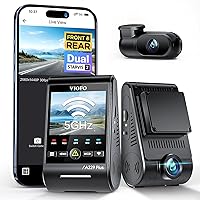
How Long Do Dash Cams Last?
Most dash cams last about 2 to 5 years, and the memory card often wears out first. Heat is the biggest killer, followed by constant loop recording and a weak power supply.
On this page (8 sections)
- How long do dash cams last on average?
- What shortens a dash cam's life the most?
- Does the memory card die before the dash cam?
- Does the battery or capacitor decide lifespan?
- Can a hardwire kit make a dash cam last longer?
- How does parking mode affect how long a dash cam lasts?
- How can you make a dash cam last longer?
- When should you replace a dash cam instead of fixing it?
Most dash cams last about 2 to 5 years, and the memory card often wears out first. Heat is the biggest killer, followed by constant loop recording and a weak power supply.
So when people ask how long do dash cams last, the honest answer is that the camera and the card age at different speeds.
The camera body is usually the tougher half. The card takes thousands of write cycles and sits in the hottest spot in the cabin.
That's why a failing card gets blamed on the camera more often than it should.
How long do dash cams last on average?
Expect 2 to 5 years from the camera itself. Simple single-channel models with a capacitor tend to reach the top of that range.
Dual-channel 4K units that run two sensors and write twice the data often land nearer 2 to 3 years.
The number moves with use. A camera that runs two hours a day on a commute sees far less heat and fewer write cycles than one that records 24 hours a day in a parking lot.
The first thing to fail is rarely the lens or the mount. It's the power path: a worn USB cable, a loose 12V plug or a tired hardwire connection.
Check those before you assume the camera is dead. If you're still deciding whether you need one at all, our guide to do I need a dash cam covers the cases where it earns its place.
What shortens a dash cam's life the most?
Heat is the number one cause of early dash cam failure. A closed car in summer sun can pass 140°F (60°C), and a camera stuck to the windshield sits right in that heat.
The second cause is the memory card. Loop recording overwrites old files constantly, and each overwrite is a write cycle.
A standard card rated for photos hits its limit far sooner than a card built for continuous video.
Power problems come third. A loose plug that cuts in and out, or a hardwire kit without low-voltage cutoff, can cause corrupt files and repeated restarts.
Each hard restart stresses the camera's power circuit.
- Heat: parked in full sun, no window shade, camera stuck to hot glass.
- Card wear: a general-purpose card doing constant loop recording.
- Bad power: loose cables, poor fusing, no low-voltage protection.
- Vibration: a loose mount that rattles the camera body.
Does the memory card die before the dash cam?
Yes, usually. The card is the part doing the heavy lifting, and a worn card shows up as missing files, corrupted clips or a camera that won't format.
That often looks like a camera fault when it isn't.
A high-endurance card is designed for exactly this. The SANDISK 128GB High Endurance Video microSDXC Card is rated for up to 10,000 hours of recording, though SanDisk notes the actual hours saved are less in 4K.
It handles Full HD and 4K, and it's built to survive heat, water, shock, humidity and magnets.
The VIOFO 128GB Industrial Grade High Endurance microSDXC takes a different angle. VIOFO says it's made for high-durability use like dash cams and action cams, supports 4K recording and reaches up to 100MB/s transfer speeds.
If you already run a VIOFO camera, its own card is the low-risk match.
Whichever card you pick, replace it after about a year of daily loop recording, or as soon as it starts dropping files. For a closer look at resolution's effect on card life, see our 1080p vs 4K dash cam comparison.
Does the battery or capacitor decide lifespan?
A capacitor usually outlasts a battery. Capacitors store charge without the chemical wear that kills lithium batteries in heat, so a capacitor camera tends to hold up better in a hot cabin.
Battery-based dash cams often fail at the battery first. The cell swells or stops holding charge, and the camera loses its time and date or shuts down at random.
A swollen battery is also a safety concern, so stop using the camera if you spot one.
Capacitor models give up the parking-mode recording that a battery can support on its own. That's a fair trade for many drivers, and our supercapacitor vs battery dash cam breakdown walks through when each type makes sense.
If your camera is battery-based and already several years old, expect the battery to be the weak point.
Can a hardwire kit make a dash cam last longer?
A proper hardwire kit can help, mainly by keeping power steady and protecting the car battery. It removes the cigarette-lighter plug from the equation, which is a common failure point in older installs.
The ROVE Hardwire Kit is built for ROVE R2-4K models with a USB-C port, plus the R2-4K PRO, DUAL, DUAL PRO and R3. It supports 24-hour parking monitoring and includes fuse taps, a voltage meter and an installation manual.
Its low-voltage cutoff is 11.8VDC for a 12VDC battery and 23.6VDC for a 24VDC battery, so it cuts power before the car battery drains.
That cutoff matters for lifespan. A camera left running until the battery is flat restarts on a weak supply, and repeated hard restarts are rough on the electronics.
A kit that shuts down cleanly is gentler on the camera and on your car.
Check compatibility before you buy. The ROVE kit is made for ROVE's USB-C models, so match it to your camera's connector.
How does parking mode affect how long a dash cam lasts?
Parking mode adds wear because the camera runs when the car is off. More recording hours mean more heat and more card writes, so a camera used for 24-hour parking monitoring ages faster than one that only runs while driving.
That doesn't mean skip parking mode. It means accept the trade.
If you rely on it, plan to replace the card sooner and keep the camera cool where you can.
Heat is worse in parking mode because the car sits closed in the sun with no airflow. A camera that records all day in a hot lot is doing the hardest work a dash cam can do.
How can you make a dash cam last longer?
Keep it cool, keep the card fresh and keep the power clean. Those three habits cover most of what actually shortens a camera's life.
- Park in shade or use a windshield sunshade when you can.
- Use a high-endurance card and replace it about once a year.
- Check the mount so the camera doesn't rattle or hang loose.
- Use a fused hardwire kit with low-voltage cutoff instead of a loose plug.
- Format the card in the camera on a regular schedule.
- Wipe the lens so the camera isn't working to capture a blurry view.
None of these are dramatic. Together they're the difference between a camera that quits at 2 years and one that runs past 5.
When should you replace a dash cam instead of fixing it?
Replace the camera when the picture fails, not just the card. A blurry or washed-out image, a sensor that won't focus or a camera that won't hold settings after a card swap points to the body, not the storage.
Try the cheap fixes first. Replace the card, swap the cable, test the power supply and check the mount.
If the image is still poor or the camera still restarts, the hardware is done.
Replace a camera that's more than 4 or 5 years old rather than repairing it. Newer models pack better sensors and higher resolution for the same money, so a repair rarely makes sense on an older unit.
A camera with a swollen battery should be replaced outright.
So the short version on how long do dash cams last: plan on 2 to 5 years for the camera, and treat the memory card as a yearly wear item. Pick the SANDISK high-endurance card if you want the longest-rated card life, or the VIOFO card if your camera is a VIOFO.
Add the ROVE hardwire kit only if you run a compatible ROVE model and want clean parking power. Keep the cabin cool and the card fresh, and your dash cam will stay useful well past the low end of that range.
Frequently asked questions
Do dash cams wear out from being left in the car?
Yes. A dash cam left in a hot car ages faster because heat breaks down its battery or capacitor and stresses the card.
Parking it in shade and using a high-endurance card reduces the damage.
Is a dash cam's memory card covered by the camera's warranty?
Usually not. Most dash cam makers sell the card as a separate accessory and leave it out of the camera warranty.
A high-endurance card made for dash cams is the safer buy.
Can I keep using a dash cam that only records sometimes?
It's a warning sign. Intermittent recording, random shutdowns or a camera that won't hold the time often mean the card or power supply is failing.
Replace the card first, then check the wiring.
Does a hardwire kit shorten or lengthen a dash cam's life?
It can lengthen it when it supplies steady voltage and cuts off before the car battery drains. A loose or poorly fused connection does the opposite, so a proper kit with low-voltage protection matters.
How often should I replace a dash cam memory card?
Replace a high-endurance card after about a year of daily loop recording, or sooner if it starts dropping files. The card does far more write cycles than the camera does.